The Classic Triangle — Beijing, Xi'an and Shanghai
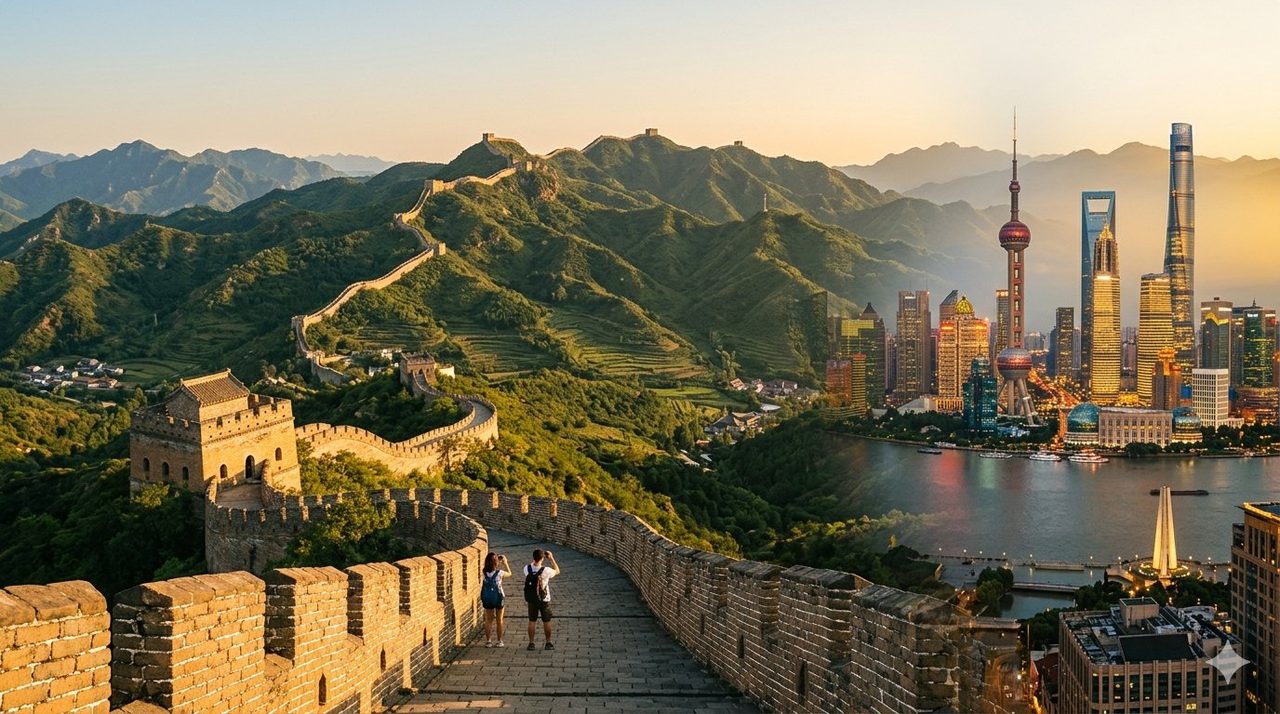
If you ask ten people who flew to China for the first time where they went, nine will say the same thing: Beijing, Xi'an, Shanghai. The Classic Triangle.
That's no accident. These three cities give you China in three different dimensions — the imperial past, the historic heart, and the dizzying future. In one trip you see where China came from and where it's going.
But the real question is: is it still the right route for you in 2026? Let's break it down city by city, and then I'll give you the honest answer.
Beijing — the imperial past
The capital. This is where China's historical weight sits, which is why most itineraries start here.
- The Great Wall — the reason many people fly here in the first place. Different sections vary in grandeur and crowds, and that changes the entire experience.
- The Forbidden City — the emperors' vast palace, the heart of China for centuries.
- Tiananmen Square and the Temple of Heaven — enormous spaces that tell the Chinese story.
- The hutongs — the ancient alleyways, where the city's old rhythm still beats.
Beijing isn't a city you love from the first moment — it's huge, crowded, and sometimes challenging. But it's essential to understanding China.
Xi'an — the historic heart
Second stop, a journey of about two or three hours by high-speed train from Beijing. Xi'an was China's capital for a thousand years, and the endpoint of the Silk Road.
- The Terracotta Army — thousands of life-size clay soldiers that guarded the emperor's tomb for two thousand years. One of the world's unforgettable sights.
- The ancient city wall — you can cycle on it, a wonderful experience.
- The Muslim Quarter — a vibrant night market with stunning, colorful and fragrant street food.
Xi'an is more compact than Beijing, and two days is usually enough. It adds a deep historical layer to the itinerary.
Shanghai — the future
The last stop, and often the favorite. Shanghai is the complete opposite of Beijing — glittering, more Western, futuristic.
- The Bund — the riverfront promenade with the famous skyline. At night it's simply breathtaking.
- The skyscrapers of Pudong — one of the most impressive skylines in the world.
- The old city and gardens — a lovely balance against the modernity.
- Nightlife, shopping and world-class cuisine — Shanghai is a city that's easy to love.
Beijing teaches you where China came from. Shanghai shows you where it's going. Xi'an connects the two.
So — is it still worth it in 2026? The honest answer
Yes — if it's your first trip to China. The Classic Triangle is a classic for good reason: it gives you the broad picture in the most efficient way, and the logistics between the three cities are relatively simple thanks to the high-speed trains.
But here's the honest caveat: it's also the most touristed route in China. If you're looking for authentic, wild China, the kind that has seen fewer tourists — the Triangle won't give you that. For that there's Yunnan, Guilin, Zhangjiajie.
My recommendation:
- First trip, limited time → the Classic Triangle. Exactly what you need.
- First trip, but you have time → the Triangle + one nature region added on (Guilin, for example). A winning combination.
- You've already been to China, or want something different → skip the Triangle and go deep into one lesser-known region.
How many days you need
The minimal classic itinerary: Beijing (3–4 days), Xi'an (2 days), Shanghai (2–3 days). In total 8–9 net days, not counting flight days. The high-speed trains connect everything comfortably and quickly — far more pleasant than domestic flights.
In the coming posts I'll get into the nature regions — Guilin, Yangshuo, and Zhangjiajie — for those who want to go beyond the classic.
SIMPLE CHINA VIP FAMILY TRAVEL
Want guidance and support for your trip?
Fill out the questionnaire and we'll be in touch.